Grid Field Container#
Artisan provides an infrastructure for managing multiple grid fields within a unified container. Users can perform operations directly on these fields, which can then be reused for lattice construction or various geometric operations. Grid field shares the exactly same data structure with the lattice field. Data points with associated field values can be fitted into a field and stored in the container. These stored fields can then be referenced as variables within field-related expressions.
The example .\Test_json\FieldContainer\FitField\FitField.json demonstrates how to fit a field into the contain variable, perform the mathematical operation, export the field, and re-import the field.
{"Setup":{  "Type" : "Sample",
            "Sample": {"Domain" : [[0.0,10.0],[0.0,10.0],[0.0,10.0]], "Shape": "Box"},
            "Geomfile": "",
            "Rot" : [0.0,0.0,0.0],
            "res":[0.1,0.1,0.1],
            "Padding": 2,
            "onGPU": false,
            "memorylimit": 1073741824000
            },
 "WorkFlow":{
      "1": {
            "OP_Fit_GridField":{
                 "inp_ptFieldFile": ".//Test_json//FieldContainer//FitField//cube_points_sdf.csv",
                 "out_gridFieldFile": "SphereSDF"
           }
               },
      "2":{
            "OP_ExprOperation_GridField":{
                "expression":"SphereSDF + 10",
                "out_gridFieldFile": ".//Test_results//OPdGridField.csv"
        }
       },
       "3":{
            "ReadGridField":{
                "inp_GridFieldFile": ".//Test_results//OPdGridField.csv",
                "Gridfield_ID": "GridField"
        }
       },
       "4":{
            "OP_ExprOperation_GridField":{
                "expression":"GridField + 1",
                "out_gridFieldFile": ".//Test_results//OPdGridField_02.csv"
            }
       }
    },
 "PostProcess":{"CombineMeshes": true,
            "RemovePartitionMeshFile": false,
            "RemoveIsolatedParts": false,
            "ExportLazPts": true}
}
Above JSON workflow includes three keywords OP_Fit_GridField, OP_ExprOperation_GridField and ReadGridField. Above workflow does the following operation.
Work item
1withŌP_Fit_GridFieldfits the data points into the grid field.Work item
2withOP_ExprOperation_GridFieldconducts the mathematical operation on the fitted field, and exports the results field into a file.Work item
3withReadGridFieldread the field back to grid field container.Work item
4withOP_ExprOperation_GridFieldconduct another mathematical operation and export the field into a new file.
Please note that above keywords in the workflow were for demonstration purpose. The resultant field in these keywords can be ID for future reference.
The parameters of ŌP_Fit_GridField is explained below.
Parameter |
Details |
|---|---|
|
A file path string to the data points. |
|
A field id that can be referenced in future and this field saves the fitted data, or a file path string to export the fitted field data. |
The parameters of OP_ExprOperation_GridField is explained below.
Parameter |
Details |
|---|---|
|
mathematical expression. The field id can referenced in this expression. The supported mathematical functions are |
|
A fitted field id, or a file path string to export the fitted field data. |
The parameter of ReadGridField is explained below.
Parameter |
Details |
|---|---|
|
A file path string to the grid field file. |
|
The required destination name for the loaded field in Artisan’s grid-field container. Later operations reference this name. |
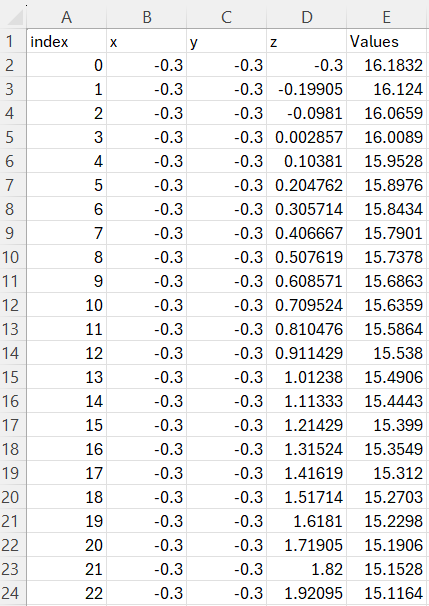
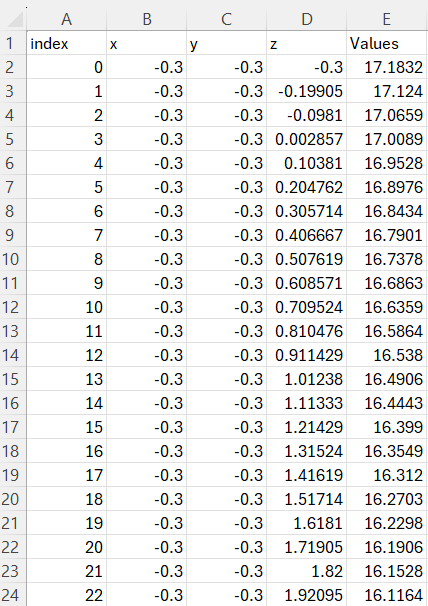
Two exported field data files were generated, OPdGridField.csv and OPdGridField_02.csv, as shown below on the left and right, respectively. In OPdGridField_02.csv, the field value was added 1 to the value of the field OPdGridField.png. This is exactly same as what defined in the workflow.
In Artisan 0.2.14, the grid field container introduces support for defining field-driven TPMS lattices. Future development will focus on extending grid field capabilities to other keywords and applications.
For HDF5 export, file layout and readback, see HDF5 field snapshots in the Export chapter.
Scalar Fields from Geometry Regions#
Define_ScalarField_CombineGeometry creates a named scalar field using
geometry regions. It samples the current lattice grid defined by Setup;
there is no separate grid_spacing. It does not change the lattice surface
field.
{
  "Define_ScalarField_CombineGeometry": {
    "field_id": "CellSize",
    "default_value": 8.0,
    "regions": [
      {
        "name": "Heel",
        "geometry": "HeelRegion",
        "value": 4.0,
        "transition_width": 12.0
      }
    ],
    "overlap": "Minimum"
  }
}
Here the field is 4 inside HeelRegion. Outside the region it smoothly
returns to 8 over a distance of 12, in the model’s units. HeelRegion must
already be loaded as a mesh-container ID, or be replaced with a mesh-file path.
Parameter |
Meaning |
|---|---|
|
Required name for the stored field, such as |
|
Required finite value used away from the regions. |
|
Required list of regions. An empty list creates a constant field. |
|
Required for each region: its surface mesh and the finite value inside it. |
|
Optional region label used in messages. |
|
Outward transition distance. Default 0 gives a sharp change at grid points; interpolation can spread that change across a grid cell. |
|
|
Minimum can only reduce the default; Maximum can only increase it.
Each positive-width transition uses a smoothstep blend. Choose Setup.res
fine enough to resolve the regions and transitions.
Geometry is handled by MeshInterface. Supply a mesh-file path or a named mesh container containing a closed, manifold, non-self-intersecting triangle surface. Exact duplicate vertices are welded; open surfaces and degenerate triangles are rejected. Volume elements are not automatically converted to surfaces.
This is a generic scalar field, so zero and negative values are allowed.
For Tetrahedral Lattice Layout from a Size Field, every value must be strictly positive and
represents a target edge length. Connect it explicitly with
"size_field": "CellSize". The field name alone does not select its use.
Save and reuse the field#
Use Export to save the values and grid coordinates in HDF5:
{
  "Export": {
    "outfile": ".//Test_results//CellSize.h5",
    "GridFieldIDs": ["CellSize"]
  }
}
In a later workflow, load the saved field before the mesher step:
{
  "ReadGridField": {
    "inp_GridFieldFile": ".//Test_results//CellSize.h5",
    "FieldID": "CellSize",
    "Gridfield_ID": "CellSize"
  }
}
FieldID selects the saved field; Gridfield_ID names the loaded field.
A partitioned file also needs BlockID. Loading one partial block does not
provide the complete field required to mesh an entire solid.
The standalone field example is
Test_json/FieldContainer/CombineGeometry/CombineGeometry.json.
For field creation, tet meshing and conformal infill together, see
Meshing 03.